
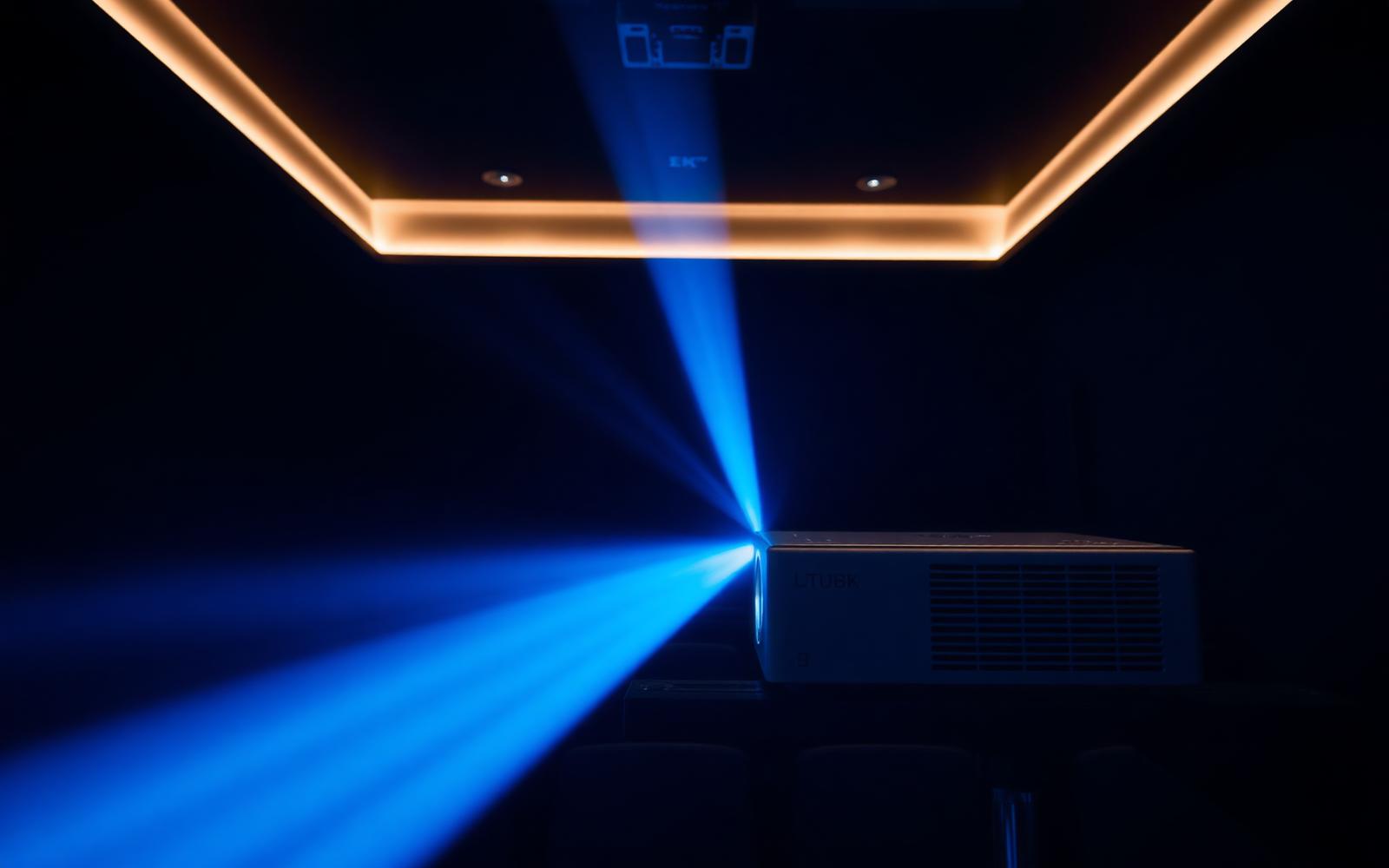
Between roughly 2009 and 2014, the movie exhibition industry executed the fastest and most complete technology replacement in its hundred-year history. Every commercial screen in North America — tens of thousands of them — replaced a machine that had barely changed in principle since the 1920s with a computer.
Most audiences never noticed, which is precisely the point. But what happens in a projection booth now is genuinely different from what happened there twenty years ago, and it is worth understanding, because it explains a lot about why a theatre looks and sounds the way it does.
The movie arrives on a hard drive
A modern feature film is delivered as a DCP — a Digital Cinema Package. Physically, it is usually a ruggedized 2.5-inch hard drive in a plastic shipping case, or an encrypted file transfer over a dedicated satellite or fiber link. Logically, it is a folder structure containing image files, audio files, subtitle assets, and XML files that describe how they fit together.
A DCP for a two-hour feature typically runs between 100 GB and 300 GB. The image is stored as JPEG 2000 frames — every single frame compressed individually, with no interframe compression. This is deliberately different from consumer video codecs like H.264 or HEVC, which achieve much smaller files by describing how each frame differs from the last.
Why the inefficient approach? Two reasons. First, quality: intraframe compression avoids the motion artifacts that appear in fast-moving or high-detail scenes. Second, robustness: if a frame is corrupted, you lose one frame, not the following six seconds. In a theatre with two hundred paying customers, that matters.
Data rates run up to 250 megabits per second. For scale, a high-quality 4K stream at home usually lands around 15 to 25 Mbps. The theatrical version of a film is carrying roughly ten times the data.
The key expires
Here is the part most people find surprising. A DCP is encrypted, and the theatre cannot play it without a separate file called a KDM — a Key Delivery Message.
A KDM is generated by the distributor and is locked to three things: a specific film, a specific projection server (identified by its security certificate), and a specific date-and-time window. Load the movie a week early and it will not play. The key opens on the release date and closes when the run ends.
This has real operational consequences. A last-minute schedule change may require a new key from the distributor. A projector's security module failing means every key for that machine must be reissued. And there is a genuine deadline pressure to booth work that did not exist when a print was a physical object you simply threaded up.
It also solved piracy at the source. In the film era, prints could be stolen or duplicated. A DCP without its key is an inert pile of encrypted data.
Inside the projector: millions of mirrors
The dominant technology in commercial cinema projection is DLP — Digital Light Processing, originally developed by Texas Instruments.
At the heart of a DLP projector is a DMD, a Digital Micromirror Device: a chip covered in microscopic aluminum mirrors, one per pixel. A 4K cinema chip carries roughly 8.8 million of them (4096 × 2160). Each mirror is mounted on a hinge and can tilt between two positions thousands of times per second — toward the lens, or away into a light trap.
Grayscale comes from duty cycle. A mirror that spends 60% of a frame's duration tilted toward the lens produces a pixel at 60% brightness. Color comes from using three chips — one each for red, green, and blue — with the light split by prism and recombined on its way to the lens.
The result is a system with no moving film, no registration drift, no scratches, no frame jitter, and no degradation between the first showing and the four-hundredth. In the film era, a print visibly deteriorated over a run: scratches accumulated, splices appeared where the projectionist repaired breaks, and the color faded. Audiences on week four literally saw a worse movie than audiences on opening night. That problem simply no longer exists.
Light: xenon, and now laser
For most of the digital era, the light source was a xenon short-arc lamp — a pressurized bulb striking an arc between two electrodes, producing an intensely bright, broadly white light. Cinema xenon lamps run from about 1 to 7 kilowatts depending on screen size.
They also have real drawbacks. They dim measurably over their 500–1,500 hour service life, they run extremely hot, they are pressurized to the point that handling requires face shields and body protection, and they consume enormous power.
The industry is now well into a transition to laser illumination, which offers longer life (20,000+ hours), stable brightness over that life, a wider color gamut, better contrast, instant on/off, and dramatically lower energy consumption. The tradeoff is a much higher upfront cost per screen, which is why the transition has been gradual and why plenty of excellent xenon rooms are still running.
Either way, the target is a standard: 14 foot-lamberts of reflected light at the center of the screen for 2D presentation, as specified by SMPTE. Screens that measure meaningfully below that are why some people say a theatre "looked dim." It is a measurable, correctable fault, and a well-run booth measures it.
The screen is a piece of engineering
A cinema screen is not a white wall. It is a precisely specified surface with a defined gain — the ratio of light reflected toward the audience versus a perfect diffuse reflector.
- Matte white screens (gain around 1.0) scatter light evenly. Best for wide seating angles.
- High-gain and silver screens (1.8 to 2.4) reflect light more directionally, appearing brighter to viewers near the center axis and dimmer at the edges. Silver screens preserve light polarization, which is why they are required for most polarized 3D systems.
Screens are also perforated with thousands of tiny holes. This is not a manufacturing artifact — the main speakers sit behind the screen, and the perforations let sound through. It is why dialogue seems to come from the actor's mouth rather than from a box on the wall.
The rest of the room matters too. Dark, non-reflective walls and ceilings prevent light bouncing back onto the screen and washing out black levels. This is the single biggest reason a theatre's contrast beats a living room's: your living room has beige walls and a window.
Sound is where the gap is widest
Picture quality at home has genuinely closed much of the distance. Sound has not, and it is not close.
A standard cinema installation includes three screen channels (left, center, right), a dedicated low-frequency effects channel, and surround arrays along the side and rear walls. Immersive formats add height channels and object-based rendering that positions individual sounds anywhere in three-dimensional space.
The reasons a theatre sounds different come down to physics that a living room cannot cheat:
Headroom. Cinema systems are designed to reproduce peaks around 105 dB per screen channel and 115 dB in the LFE channel without distortion. Doing that requires amplifier power and driver surface area measured in square feet.
Low frequency extension. Reproducing a clean 25 Hz requires moving a great deal of air. The subwoofers behind a cinema screen are physically enormous — and a wavelength that long simply does not develop properly in a small room.
Room design. Auditoriums are acoustically treated: angled walls to break up standing waves, absorptive surfaces to control reverberation time, and isolation from adjacent auditoriums so the action film next door does not intrude on the drama.
Calibration. A cinema sound system is measured and equalized to an industry-standard response curve using a calibrated microphone at multiple seating positions. Almost no home system is professionally calibrated this way.
Dynamic range is the practical result. A film mix uses the quiet parts as much as the loud ones. Home listening compresses that range — because of neighbors, sleeping kids, and speaker limits — which is why so many people watch at home with subtitles on. In a properly calibrated auditorium, a whisper is intelligible and an explosion is startling, and both are as the mixers intended.
What a projectionist actually does now
The romantic image is a person threading film through a projector and changing over reels. Modern booth work is different but not trivial.
Ingest. Loading DCPs onto the server, verifying checksums, and confirming the correct version — 2D versus 3D, the right language, the right aspect ratio.
Key management. Requesting, installing, and verifying KDMs, and catching a key problem before an audience is seated rather than after.
Playlist building. A "show" is a programmed sequence: pre-show slides, trailers in a specified order, policy trailer, feature, credits, and automation cues that dim house lights, open masking, and adjust volume at defined points.
Monitoring and maintenance. Checking screen brightness, cleaning optics and filters, monitoring lamp hours, verifying sound levels, and watching for the slow drift that audiences perceive as "something felt off."
Troubleshooting live. When a server stalls or a sound processor drops out, someone has to diagnose it in the dark in under two minutes.
The job became less mechanical and more diagnostic. It did not become unnecessary. The theatres where nobody does this work are exactly the theatres where the picture is dim, the sound is thin, and the customer decides home is better.
What this means when you buy a ticket
You are not paying for access to a movie. Access is cheap and getting cheaper. You are paying for a specific technical presentation of it:
- An 8.8-million-pixel image at 14 foot-lamberts on a calibrated, high-gain surface
- In a room engineered to eliminate reflected light
- With a multichannel sound system capable of 105 dB peaks and clean output below 30 Hz
- Tuned to a professional standard
- Presented as the filmmakers signed off on it, without compression artifacts or a compressed dynamic range
That is a stack of equipment and expertise that would cost several hundred thousand dollars to approximate in a private home, and it still would not have two hundred other people reacting at the same time.
Next time the lights go down and the image comes up, there is a machine full of mirrors upstairs doing something remarkable eight million times per frame, twenty-four times per second. We think that is worth knowing about.